
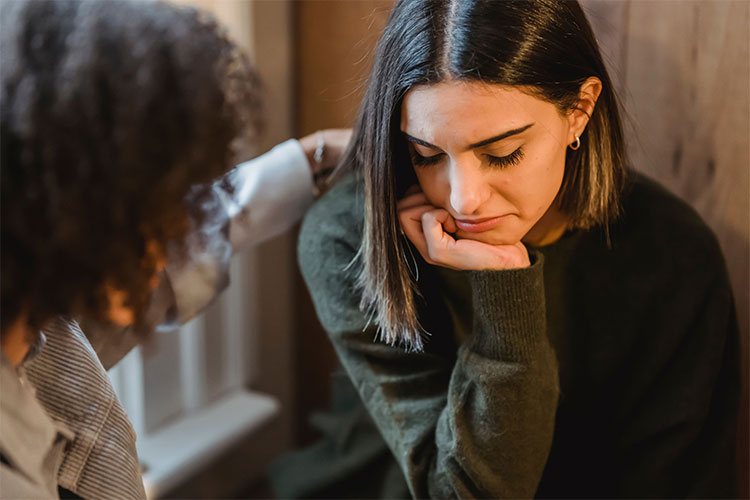
There is a particular kind of grief that doesn’t announce itself as grief. It doesn’t look like sadness, exactly. It looks like replaying a phone call you didn’t make. It looks like feeling vaguely wrong for laughing at something, for being hungry, for still being alive on a Tuesday when your brother or sister is not.
It is called survivor’s guilt, and for those who have lost a sibling, it can be one of the most quietly devastating — and least talked about — dimensions of bereavement.
What Is Survivor’s Guilt?
Survivor’s guilt is the psychological distress that arises when someone survives or escapes a situation relatively unharmed while others do not. It is not simply sadness about what happened. It is a specific, self-directed torment rooted in the question: Why me and not them?
The term was first introduced by psychiatrists Dr. Stanley Cobb and Dr. Erich Lindemann in 1943, and became more widely studied in the aftermath of World War II, when clinicians working with Holocaust survivors found that many were paralyzed not just by grief, but by a profound sense of guilt for having lived when so many others — neighbors, friends, family — had not.
Since then, the concept has expanded far beyond wartime. Survivor’s guilt has been documented in first responders, cancer survivors, disaster survivors, and family members bereaved by sudden loss.
It was once formally listed as a symptom of post-traumatic stress disorder in the DSM-III, and while it is no longer classified as a standalone diagnosis, it remains closely associated with PTSD, major depressive disorder, and complicated grief.
Survivor’s Guilt and Sibling Loss
When a sibling dies — whether from illness, accident, suicide, or overdose — survivor’s guilt is a natural, if painful, response. And it can take many forms.
You might feel guilty simply for being alive, especially if the death was sudden or random — an accident that could just as easily have taken you. You might replay moments from the past, searching for things you said or didn’t say, calls you didn’t return, arguments that went unresolved. If your sibling struggled — with illness, addiction, mental health — you may ask yourself why you didn’t do more, intervene sooner, see the signs.
For some, the guilt is entangled with relief — relief that they didn’t suffer, or that a long illness is over — and then guilt about the relief itself. This layering of emotions can be particularly difficult to name or share with others.
Common experiences of survivor’s guilt after sibling loss include:
- The endless “what if” loop — replaying decisions, conversations, and moments in search of a point where things could have gone differently
- Feeling undeserving of happiness — an inability to celebrate milestones, enjoy relationships, or move forward without a sense of betrayal
- Anger turned inward — rage at the loss that has nowhere to go, becoming self-blame
- Hypervigilance — a heightened fear of future losses, or an overactive stress response that keeps the body on constant alert
- Social withdrawal — the assumption that others blame you the same way you blame yourself, leading to isolation
Physically, survivor’s guilt can manifest as fatigue, insomnia, headaches, loss of appetite, and a persistent heaviness that makes ordinary life feel effortful or undeserved.
The Sibling Dimension
Survivor’s guilt in the context of sibling loss carries some unique characteristics. Your sibling likely shared your history more intimately than almost anyone else — the same childhood, the same parents, the same family mythology.
Losing them doesn’t just mean losing a person. It can mean losing the only witness to your earliest self.
There is also, often, a profound sense of disorder. We expect to lose parents. We do not expect to lose siblings — especially not before midlife. When the loss happens, it disrupts our sense of how life is supposed to unfold. And that disruption can amplify guilt: I survived the same family, the same upbringing, the same risks. Why didn’t they?
Research has shown that sibling loss is associated with a significantly lower sense of meaningfulness and self-worth compared to other kinds of bereavement.
Bereaved siblings are far more likely to experience complicated grief — a persistent, prolonged form of mourning that doesn’t follow the expected trajectory of healing. Unaddressed, survivor’s guilt contributes directly to that complication.
Why We Don’t Talk About It
Part of what makes survivor’s guilt so hard to address is that it exists in the shadows of a grief that is already under-acknowledged. Adult siblings are frequently the “forgotten mourners” — the family members who are expected to hold things together for parents, for children, for everyone else — while their own grief goes largely unseen.
When survivor’s guilt sits inside that invisible grief, it can fester quietly for years. It can resurface at a sibling’s would-be birthday, at your own wedding, at the birth of a child they never got to meet.
People around you may not even realize what you’re carrying, because the language for it is so limited, and the cultural scripts for sibling mourning are so sparse.
Finding a Way Through Survivor’s Guilt
Survivor’s guilt is not something to reason your way out of. You cannot think your way to the conclusion that the loss wasn’t your fault and then feel free. The healing process is slower and less linear than that. But there are pathways through it.
1. Name it
The first step is simply recognizing what you’re experiencing. Survivor’s guilt masquerades as many things — depression, anger, numbness, overachievement, self-destruction. Naming it as survivor’s guilt, and understanding it as a known, documented psychological response, can begin to loosen its grip.
2. Allow the feelings without acting on them
Guilt, shame, and self-blame are feelings, not verdicts. Letting them exist without treating them as evidence of your actual culpability is difficult, but important. You are allowed to feel your grief in all its complicated forms without punishing yourself for it.
3. Seek grief-specific support
Standard grief counseling doesn’t always address survivor’s guilt directly, and general therapy may not be attuned to the specific terrain of sibling bereavement. Look for therapists who specialize in complicated grief or trauma.
Support groups for bereaved siblings — many of which now exist online — can offer the particular comfort of being understood by people who have been through something similar.
4. Find ways to honor, not erase
Many people find that channeling their grief into something meaningful — a charitable act, a creative project, a way of carrying their sibling’s values forward — helps transform the guilt into something generative.
This isn’t about fixing the loss, or earning the right to still be alive. It’s about finding a way to hold both truths at once: that they are gone, and that you are still here, and that both things matter.
5. Be patient with yourself
Healing from survivor’s guilt is not a straight line. It asks for something that grief rarely makes easy: self-compassion. The goal, ultimately, is not to erase the guilt — it may never fully disappear — but to integrate it in a way that allows you to live fully, and to honor the sibling you lost by doing so.
A Note on When to Seek Help
If survivor’s guilt is leading to thoughts of self-harm, significant impairment in daily functioning, or substance use as a coping mechanism, please reach out to a mental health professional.
In the U.S., the 988 Suicide and Crisis Lifeline (call or text 988) is available 24/7. The National Alliance on Mental Illness (NAMI) Helpline can also connect you to resources: 1-800-950-6264.
You survived. That is not a crime. It is, in its own painful way, a kind of gift — one that takes time, support, and care to be able to receive.
Key Research & Academic Studies
- A 2025 meta-ethnographic synthesis published in Taylor & Francis analyzed 10 studies on adult sibling bereavement and identified three major themes: “Death’s Ripple Effect,” “The Space Between Grief and Healing,” and “Navigating a New Reality” — highlighting how surviving siblings face fractured parallel lives, role substitution, and identity disruption. Taylor & Francis Online
- A widely cited PubMed study of 107 young adults found that those who lost a sibling were far more likely to experience complicated grief (57%) compared to those who lost a close friend (15%), with significantly higher rates of depression and physical symptoms. PubMed
- Research indicates that roughly 25% of Americans experience sibling loss by age 40, and unaddressed grief correlates with higher rates of depression, anxiety, and physical health problems. AHEAD
- A Norwegian nationwide study explored grief adjustment in young adults 2–10 years after losing a sibling to cancer, finding that resilience and social support were key factors in how well people adapted long-term. NIH
About the Author:

Susan Podbielski
Licensed Mental Health Counselor
With over 10 years of experience as a licensed therapist, Susan Podbielski specializes in helping people overcome anxiety, depression, and the debilitating effects of past trauma through a practical, collaborative approach.
She combines evidence-based tools, including CBT, DBT, mindfulness, and self-compassion techniques, to meet each client’s specific needs and goals.